
Where Are VR Simulators Commonly Used?
VR simulators have evolved far beyond niche gaming gadgets. Today, they are sophisticated systems deployed across a diverse range of sectors to solve real-world problems: from driving revenue in entertainment venues to enhancing safety in high-risk industries. As a leading developer and manufacturer of commercial-grade VR equipment, FuninVR works directly with clients worldwide to deploy solutions in these varied environments. Understanding where VR simulators are commonly used reveals not only the technology’s versatility but also its transformative impact on training, education, and guest experiences.
Below are the most common application scenarios where VR simulators are successfully deployed around the world.
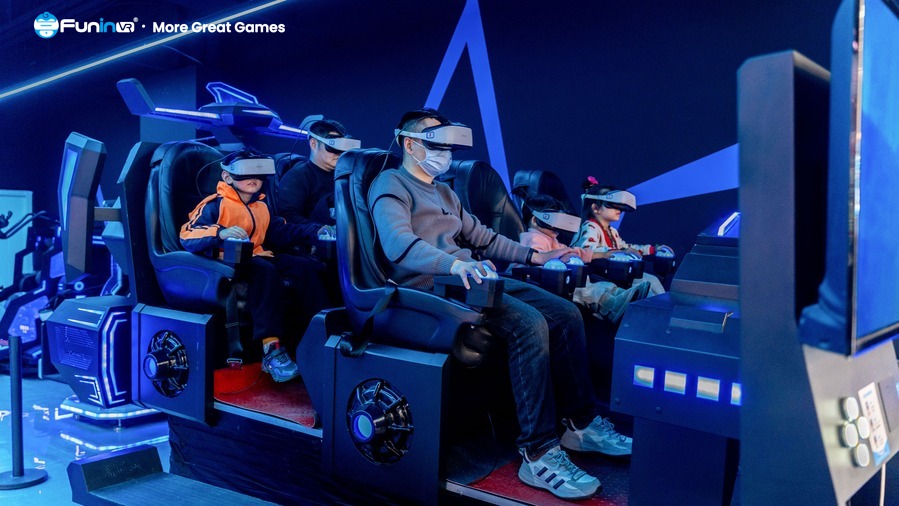
VR Arcades and Game Centers
VR arcades are the most familiar environment for VR simulators. These venues typically combine multiple simulator types—such as shooting simulators, racing systems, and motion platforms—to appeal to a wide range of players.
In this setting, durability, ease of operation, and content variety are key. Equipment must support high daily usage while offering experiences that are easy for first-time users to understand. Manufacturers like FuninVR, with experience in both VR and traditional arcade equipment, often design simulators specifically for fast turnover and long-term operation.
Shopping Malls and Entertainment Complexes
Shopping malls use VR simulators as experience-driven attractions that complement retail and dining. Motion theaters, enclosed VR cabins, and compact motion simulators are commonly installed due to their strong visual impact and efficient space usage.
In these environments, simulators are expected to be safe, visually appealing, and capable of handling high foot traffic during weekends and holidays. Short, immersive VR films or ride-style experiences tend to perform best.
Theme Parks and Tourist Attractions
Theme parks and scenic areas often use VR simulators to enhance storytelling or add interactive elements to existing attractions. Large-scale motion platforms, 6DOF VR simulators, and multi-seat systems are popular choices in this category.
These venues prioritize immersion and throughput. A well-designed VR simulator can operate continuously while delivering consistent experiences to large numbers of visitors, making it a strong fit for tourism-driven locations.
Entertainment Venues and Family Fun Centers
Family entertainment centers (FECs) rely on VR simulators to offer age-inclusive experiences. Racing simulators, motion rides, and non-violent shooting games are commonly selected to appeal to both teenagers and adults.
Here, flexibility matters. Venue owners often prefer modular VR simulator solutions that can be adjusted or expanded over time. Manufacturers that offer multi-device combinations and content customization help operators adapt to changing customer preferences.
Street Arcades and Overseas Game Halls
In many overseas markets, VR simulators are widely used in street arcades and independent game halls. Compact, plug-and-play systems—such as enclosed VR cabins or single-seat motion simulators—are especially popular.
These venues value equipment that is easy to install, visually eye-catching, and simple to maintain. Custom-themed designs and localized VR content are often used to better match regional tastes.
Exhibitions, Events, and Promotional Spaces
VR simulators are also frequently used in exhibitions, trade shows, and brand activation events. In these temporary setups, portability and reliability are more important than long-term throughput.
Simulators used in events often focus on short, impactful experiences that can attract attention quickly and leave a strong impression on users.
Professional Training & Simulation: Where Precision and Safety are Paramount
In this sector, VR simulators are critical tools for skill acquisition, procedural practice, and risk mitigation in environments where real-world training is costly, dangerous, or impractical.
-
Aviation & Aerospace: Full-flight simulators (FFS) have used advanced motion and visual systems for decades. Modern VR integration now provides more accessible cockpit familiarization, emergency procedure drills, and maintenance training at a fraction of the cost of traditional FFS.
-
Automotive & Transportation: From training bus and truck drivers in hazard perception to teaching automotive assembly line workers complex procedures, VR simulators offer a safe, repeatable, and measurable training environment. High-fidelity driving simulators are also used for vehicle design and ergonomics testing.
-
Healthcare & Medicine: Surgical simulators allow medical students and professionals to practice procedures with haptic feedback that replicates the feel of tissue. They are also used for patient diagnosis training, rehabilitation therapy, and treating phobias through controlled exposure.
-
Industrial & Emergency Services: This includes training for operating heavy machinery (e.g., cranes, excavators), conducting safety walkthroughs of hazardous sites like oil rigs or chemical plants, and rehearsing complex emergency response scenarios for firefighters and police.
For businesses and institutions looking to leverage this technology, partnering with an experienced VR simulator manufacturer like FuninVR is crucial. Our role extends beyond supplying hardware; we provide comprehensive VR entertainment and simulation solutions tailored to the unique demands of each sector—be it a robust 6DOF arena for an entertainment center or a specialized training module for an industrial client. By understanding the nuanced needs of these diverse applications, we help clients deploy VR simulators that are not just technologically impressive, but commercially and operationally successful.
VR simulators, VR arcades
MAY BE YOU LIKE ALSO

© 2019 All rights reserved by Zhuoyuan Co., Ltd